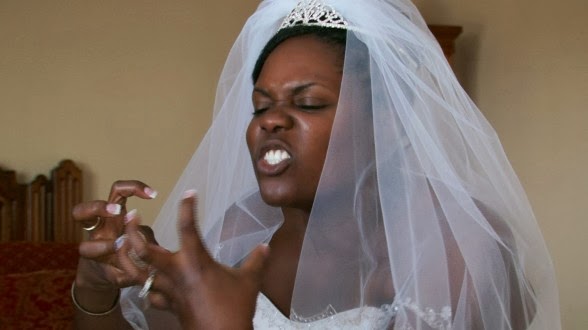
The Price of Gold
You guys, you guys, you guys. Nancy Kerrigan and Tonya Harding. You know you love this shit. We were treated to a recap of the Nancy and Tonya saga during this past Olympics in Sochi. NBC produced an original docu that aired, weirdly enough, before the ladies' singles figure skating finals. For the NBC production, Mary Carillo was able to gain access to Harding and Kerrigan for sit-down interviews. The Price of Gold was produced as part of ESPN's 30 for 30 series, and features mostly interviews with Harding, Harding's childhood friends, and former coaches. Kerrigan only makes an appearance in figure skating and news footage.
The subject of many a late-night joke, the Nancy and Tonya story was one of those media events that took on a life of its own, garnering hours of media coverage and pages of newsprint devotion. The event and the spectacle that followed has not yet been forgotten by the public consciousness. It elevated the popularity of the sport, and apparently Tonya's side of the story has been turned into a musical. (The part of my brain that loves trashy media is super stoked about the latter.)
The story was simple enough. Tonya Harding was the 1991 Skate America champion, U.S. figure skating champion and a second-place finisher at Worlds. Not too bad for a girl who grew up in a poverty-stricken and dysfunctional family and who famously took skating lessons at the local mall because she couldn't afford to study privately. She was blue-eyshadowed and a little trashy, and definitely didn't fit the mold of the Disney princess-esque pseudo pageant queen that some figure skating fans have come to expect and demand. Contrast that to Nancy Kerrigan, who grew up in a working-class but loving and stable family and who fit the stereotype of the beautiful and balletic skating champion. In spite of Tonya's seeming disadvantages, it was she who won the U.S. National title in 1991, with Kerrigan coming in second.

In spite of their differences, both ladies seemed poised to take home a medal at the 1994 Winter Olympics in Lillehammer, Norway. Then things all kind of went to shite. On the morning of January 6, 1994, just weeks before the start of the Olympics, Nancy Kerrigan was clubbed in the knee as she came out of practice at Cobo Arena in Detroit. At first, the attack seemed to have come out of the proverbial ether, but suspicion soon fell on Tonya Harding after it was revealed that Kerrigan's assailant, Shawn Eckhart, was associated with Harding's ex-husband, Jeff Gillooly. Harding was accused of masterminding the plot against Kerrigan. The motive? Jealousy. Money. The usual suspects.
.jpg)
We skate to the death!
You see, although Harding had the titles, Kerrigan had all the corporate sponsorships, and thus, all the money. (Kerrigan was famously gifted with Olympic skating outfits by fashion designer Vera Wang.) Harding was struggling financially (she became famous for her "homemade" costumes) and felt unsupported financially by her skating federation, and was angry that no corporations had approached her, whereas Kerrigan had lined up sponsors ranging from Campbell's Soup to Evian Water. Remember, Harding was the champion, not Kerrigan.
The theory is that Harding felt Kerrigan was her biggest competition for the gold medal. The federation, and the corporate sponsors, clearly adored Kerrigan. Nothing was ever proven against Harding, but the suspicion was that Harding thought if she could knock Kerrigan out of contention for the gold medal in Lillehammer, then she would almost certainly win. The incentive for winning the gold was motivation enough. The gold medal comes with not only all the media exposure, but a cash prize, and is generally accompanied by the aforementioned corporate sponsorships.
Harding's feelings, according to the 30 for 30 interview, are that there is a lot of corruption in the figure skating world, and that the Olympic champion is "pre-selected" from among a list of acceptable candidates. Harding's current feeling is that her skating federation thought she was fine as the U.S. champion, but she wasn't acceptable as a World or Olympic champion, regardless of what she'd done at the 1994 Winter Games. Her homemade costumes, her athletic style, and her mouthy attitude were not marketable. (Every time I picture figure skating authorities, I picture Barry Fife from Strictly Ballroom. See below.)

To date, Tonya Harding retains her innocence. She was stripped of one of her U.S. National Champion titles and due to her famous "skate lace malfunction," did not medal at the 1994 Olympics. Nancy Kerrigan did not win gold that year, either. That honor went to Ukrainian upstart, Oksana Baiul.

Nancy Kerrigan retired from amateur figure skating competition after Lillehammer.
Harding was banned from figure skating for life and never skated professionally again.
The sad part of it all was that Harding was a very talented, if troubled, skater. She went down in history as the first woman to land the difficult triple axel in competition.

Why, why, why?
Schooled: The Price of College Sports
You want to get schooled?
Gather round children and hear the tale of the NCAA. This documentary is about a sports scandal, but it makes the Harding/Kerrigan fiasco look like amateur hour. I am a big supporter of college sports and of my alma mater (WE ARE SPATANSSS!!!), so this documentary made me several kinds of angrysad.
Schooled is an expose of the shocking level of greed and corruption that has taken over the NCAA. It focuses on college players, "student athletes," who are being taken for a ride at the hands of a supposedly beneficent system.

Let's pretend you are a high school athlete who has been recruited by a major football university to play gridiron football for that school, and in the process, you will be earning the school major buck$$$ as well as potentially helping the team to a national title. If all goes well and you are not injured in play, you can then be recruited by the pros. In exchange, these 17 and 18-year-olds receive tuition, room and board, and a college education that, in other circumstances, they may not be able to attain.
Sounds like a great deal, right? Well, it's more complicated than that. As recent debates have indicated, college players are agitating for more compensation, unionization, and pay-to-play. Why have they got such a problem? The deal the athletes make with the NCAA is not as great as it seems on the surface.
College sports in the United States is a multi-billion-dollar industry. Colleges and universities make serious bank off tickets, concessions, and merch. So, the players get a cut of that, of course. Ehhh, not so much. Profits from football and basketball games go to the NCAA and the schools. Players are actually banned by NCAA rules from making any money off their likeness. For example, if you are a star quarterback for University of State U., the school may manufacture as many jerseys with your starting number on it, but they will not pay you any of the proceeds. If the school decides to make your team the subject of a video game created by EA sports, they can manufacture a computer generated image of you, call it you, stick your jersey number on it, sell the game, make a profit, and they do not cut you a check. They can also make multi-million-dollar deals with television networks to air games in which your team will play. Again, no dohlars for you.

But, but, but, Arsenic Pie, they get a free education! That's enough, right?
Ehh, yeah. About that "education." This is not to say that there isn't such a thing as an outstanding student and athlete at the college level. However, many athletes who are recruited by universities are not academically prepared for the rigors of a college education. Athletes are often admitted on a special status -- that means they often have lower grades and SAT scores than regular students. For example, Stanford University, with a big football program, is famously highly selective of its undergraduate students. I am not being a snob here, but higher grades and test scores are often the result of better pre-college academic preparation (they are often also a function of class privilege and wealth, but that's for another day), and better pre-college preparation often, but not always, results in higher levels of success in college. (Author's note: I slacked off in high school but graduated college with a 3.7 #humblebrag.) Regular students at University of State U. are expected to attend a certain number of class hours and keep themselves out of academic probation. Student athletes are expected to remain academically eligible to play, in addition to the 40 to 50 hours a week they are expected to be in training and practice. There is really not a whole time for the athletes to attend class or study. This has given rise to "special classes" for athletes, in which they are required to write a paper or read a book, or some other essentially symbolic classwork that they actually have time to do. This has led to "outrage" over student athletes taking "fake" classes. Whether the classes are "fake" or not, what's true is that the athletes are not getting the same quality of education that the normally matriculated students are getting. It may be free for many of the athletes but, I guess...uh...you get what you pay for. (???) Since student athletes have to stay academically eligible to play, and since many of them are academically unprepared, and since many athletes do not have time to keep up with a regular course load on top of their training schedule, is it really any wonder that universities have resorted to giving athletes special classes so they can stay eligible? Because the schools are deliberately recruiting athletes that they willingly know are woefully academically unprepared in order to have a better team so they can win more games. Winning more games = more potential for a championship title. Winning a championship title = more money. So, the argument that they're getting a free education in exchange for their play doesn't hold much water with me. If it's not of the same quality as the other degree-holders from the same university, then it is separate and it is unequal. Athletes often do not finish their degrees, and leave for paid play in the pro leagues. Who can blame them? They either don't have time to get a part-time job or they're not allowed to, so if their families can't support them financially, how do they live? Student athletes have complained about their inability to buy food. With coaches and administrators pocketing million-dollar paychecks, and with the NCAA making billions, this is an outrage.

If the student athlete is injured and can no longer play, they lose their athletic scholarship. If they cannot afford to continue with their education, they must either leave school or take out loans. Then they would be expected to finish their education taking normal classes, which they may or may not be ready for.
So, the athletes can just choose not to sign a contract with the NCAA, right?
Nope. All NCAA accredited schools (read: the big sports schools) require student athletes to sign a contact in order to play.
So, if they don't want to play by the NCAA's rules, they can just choose not to play, right?
Right, and they can miss out on the potential for a lucrative career in the pros. For talented athletes, that may be their only avenue out of poverty.
Oh, and the NCAA is a non-profit organization. So all of that profit that they make off the efforts of young players is tax-free.

The lesson for student athletes is, if you want to have a chance to make it to the pros, you had better be prepared to make a deal with the devil.
Bigger, Stronger, Faster
Onward to more controversy! I'm feeling British today, so you must read that as conTRAHvahsy.
So...steroids. I am from the generation that was brought up to be scared poopless of using steroids. I was warned if I ever put anything that resembled an anabolic steroid in my booty to enhance athletic performance (not that 13-year-old me wanted to excel athletically), I would immediately turn into a cyborg.

I was warned that if I used steroids, my boobs would shrink and my period would dry up. I was on board with all that and was about to shoot up until they mentioned the lady facial hair part. I was obedient enough to ingest the information in my "good life choices" classes presented by sexually repressed adults so that I have more or less avoided all of the "risky" behavior that they warned us against.
Given that, I was really surprised that I ended up enjoying Bigger, Stronger, Faster: The Side Effects of Being American.

I wouldn't say it is pro-steroid in any way, but it does ask some interesting questions about the mixed messages we send about body image (to men as well as women, but this is one of those rare documentaries that focus on male body image) and about durgs. I mean drugs. I mean. OYU UDN'TSLHO UES DURGS. Why is our society accepting of the use of certain drugs, and we have deemed other drugs to be "bad"? After all, caffeine is a drug that enhances performance (increase in energy) and I've had three cups of butter coffee and a Diet Coke already today and it's not even noon. Butter coffee, you guys.

Bigger, Stronger, Faster focuses on Christopher Bell and his two brothers, Smelly and Mad Dog. Both of Bell's brothers are steroid users, and Mad Dog suffered from drug addictions that eventually took his life in late 2008. The documentary examines the use of anabolic steroids and its relationship to the American Dream.

I liked this documentary because it pointed out the hypocritical way in which Americans view drugs. On the one hand, Americans decry steroid use, but they spend millions on the rather shady supplement industry. Similarly, some drugs are labeled as steroids and athletes are banned from using them, but they are able to take cortisone shots (Spoiler alert: cortisone is also a steroid.) I think we've all seen the outrage that accompanied the revelation that Lance Armstrong was juicing.
I find the last bit especially pertinent today with the Dr. Oz controversy. People who are desperate to lose weight line up in droves to buy a chemically suspect product off an internet retailer that sprung up overnight after an airing of The Dr. Oz Show, but everyone knows that steroids are Satan's own brew.
(That's the second time I've mentioned the devil in this blog post. No known association available at publication date.)
I'm not saying I'm in favor of people going out and shooting themselves in the bum with a steroid to enhance their performance, but I do feel people ought to take a look at what sorts of drugs make someone a "cheater" and what is only an "enhancement."
Also, it features this cow:

Cow.
Shaolin Soccer
So, onto less heavy subject matter. Shaolin Soccer is a 2001 comedy from Hong Kong about a shaolin monk, Sing, who wants to promote kung fu through soccer. Very apropos, is it not? Sing dresses like Bruce Lee and recruits his fellow monks to create an unbeatable soccer team.
.jpg)
Team Shaolin enters a competition and they play against Team Evil, a team that's been injected with an American drug that has made them superhuman (I'm guessing the secret ingredient is Red Bull; I hear it gives one wings). Team Shaolin beats Team people all over the world practice kung fu in their daily lives. The plot is a bit weak, but it's a fun movie with a soccer theme. It's a Hong Kong kung fu movie, so it pays a lot of homage to Bruce Lee, which I of course appreciate. It's very promotional of kung fu, which the Chinese gubbmint seems to have no qualms with promoting. Just as long as it isn't Falun Dafa Soccer, I suppose. Didn't hear anything about that from Bob Costas in 2008, now did we?

The hypocrisy is strong with this one.
One Night in Turin
I've been watching Endeavour again, chickens. On a recent episode, England won the 1966 World Cup.
.jpg)
Footy, footy, footy. ENGLAND ENGLAND.
One Night in Turin is a 2010 documentary that focuses on the 1990 English soccer team. According to the archive footage and the narrator (Gary F*cking Oldman), by 1990, England's soccer glory days were long behind them.
.jpg)
The Scottish Football and Highland Dance Team of 1966.

Strictly BallroomThe film provides a lot of context for the underdog 1990 English team's improbable journey to the World Cup in Turin, Italy. At that point in time, English fans were infamous for being HOOLIGANS and rioting during soccer matches, and the English team wasn't weren't doing so hot. England itself was suffering from a poor economy due to Thatcher-era policies. The success of the English team galvanized the nation, and brought the English a sense of national pride that they had lost.
The England team defied everyone's expectations, and not only qualified for the World Cup, they made it into the Group of 16, then the quarter finals, and then the semi-finals, where they faced West Germany, a team whose captain was a 26-year-old Jürgen Klinsmann.
The England team defied everyone's expectations, and not only qualified for the World Cup, they made it into the Group of 16, then the quarter finals, and then the semi-finals, where they faced West Germany, a team whose captain was a 26-year-old Jürgen Klinsmann.
Were you unjustly robbed of your title as Pan-Pacific Amateur Five-Dance Latin Final Champion? At the Pan-Pacific Grand Prix? Well, guess who else had that happen to him? Scott Hastings, that's who!

SCOOOOOTTTTT!!!
I don't care how much you love Moulin Rouge. This is Baz Luhrmann's best movie. The first movie in Luhrmann's Red Curtain trilogy, Strictly Ballroom makes me happy and full of twenty kinds of joy. If you ever watch it with me, I WILL quote it and I WILL totally spoil it for you
The plot is pretty simple. It's about Scott Hastings (Paul Mercurio), a rising star in the world of Australian dancesport. Scott is tired of dancing the old steps taught by his dancing instructor and his mother, a former amateur dancer herself (who now teaches dance and sells cosmetics on the side).

Scott wants to dance NEW STEPS with his partner, Liz Holt, but Liz definitely does not want to dance NEW STEPS. Liz drops Scott after an argument, and she partners instead with That Drunk Ken Railings. Scott needs a new partner fast, and he is approached by the awkward, acne-ridden Fran (Tara Morice).

Fran is willing to dance NEW STEPS, so Scott gives her a chance. He meets her Spanish-speaking family, and Fran's father teaches them the steps to the pasodoble. The pasodoble is not new per se, but it is new to the stuffy world of Australian amateur five-dance Latin final. (The pasodoble literally means "double-step" in English, and it was originally a French dance that is danced in Spain and other Spanish-speaking communities.)
.jpg)
¿Tu bailas pasodoble?
Fran transforms herself from a wallflower beginner to an accomplished dancer and hottie. Scott and Fran fall in the lovez, in spite of the opposition from Federation President Barry Fife, Mrs. Hastings, Liz, and well, everyone, except Fran's family. I first watched this in a college Spanish class and I wrote una composición en español about how awesome it is.

I believe that we will win!
*Am no way ever boycotting waffles and pommes frites.


Edited to add: I just discovered this afternoon that The Netflixes has a whole selection of soccer-themed 30 for 30 docus available for streaming RIGHT NOW Check out the collection 30 for 30: Soccer Stories. I prithee get thee to yon Netflix posthaste!